


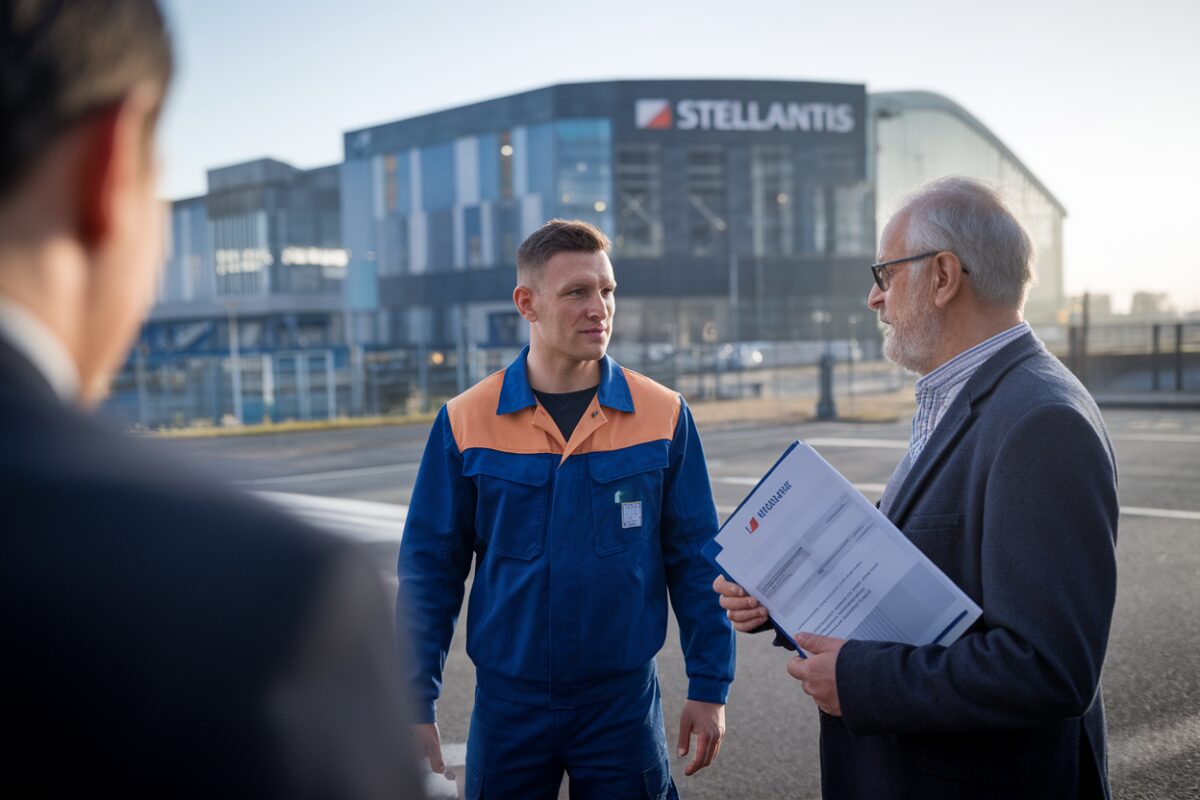
Stellantis says it will start building a vehicle for China’s Dongfeng Motor at its Rennes–La Janais plant in western France, a move that instantly calmed nerves at a factory that’s been living on a single model and a thin production schedule.
But the relief didn’t last long. On the shop floor and in union offices, the same question keeps coming up: Is this a real manufacturing program that protects jobs, or a short-term “assembly-only” deal that keeps the lights on while Europe’s auto market shrinks?
The vehicle is expected to be a premium-model from Dongfeng’s Voyah brand, according to local reporting. Stellantis hasn’t laid out key details like how many vehicles will be built, how long the contract runs, or how much of the work will actually happen in Rennes.
A second vehicle line could stabilize a plant built in 1961
Rennes–La Janais opened in 1961 and today produces just one vehicle: the Citroën C5 Aircross. That kind of single-model dependence makes any factory vulnerable, one dip in demand or a scheduling gap can quickly turn into reduced shifts and job anxiety.
So the idea of adding a second vehicle, even one wearing a Chinese badge, landed internally like a lifeline. Workers interviewed locally described a blunt reality: when a plant slows down, employees can be reassigned to other Stellantis sites, sometimes far from home. For families rooted around Rennes, forced relocation isn’t a minor inconvenience, it’s a major disruption.
Management is pitching the Dongfeng deal as a practical way to use existing equipment and keep lines running without shutting plants or cutting headcount. In plain terms: rent out capacity, keep people working.
The big fear: “Are we building cars, or just bolting together kits?”
The optimism fades when the conversation turns to what “produce” actually means. Some employees worry the Voyah could arrive largely pre-built, shipped as major modules or in CKD-style kits, leaving Rennes to do final assembly rather than full-scale manufacturing.
That distinction matters. A deeper level of local integration typically means more jobs, more skilled work, and more long-term leverage for the plant. A light-touch assembly operation can add volume without building a durable future.
Union representatives are pressing for written guarantees on the industrial content of the project: which parts will be sourced locally, what processes will be performed on site, and whether the program comes with training and investment, or just a temporary bump in output.
Stellantis’ Europe problem: too many factories, not enough demand
The Rennes deal is unfolding against a broader European squeeze. Stellantis CEO Antonio Filosa has said the company plans to cut annual production capacity in Europe by 800,000 vehicles by 2030, while also insisting the automaker doesn’t want to close plants.
For American readers, Stellantis is the multinational parent of Jeep, Ram, Chrysler, Dodge, and Fiat, formed by the merger of Fiat Chrysler and France’s PSA Group. In Europe, it operates a large network of assembly plants that were built for higher demand than the market now supports.
Filosa’s answer appears to be partnerships: bring in outside brands to fill unused capacity and spread fixed costs. He has also floated the idea of shared dealer networks, hinting at cooperation that could go beyond factory floors and into sales channels.
That raises a sensitive question inside Stellantis plants: Are these deals smart ways to protect jobs, or are they opening the door for new competitors to gain a foothold in Europe using Stellantis’ industrial and commercial infrastructure?
Poissy looms as a warning sign for workers
Workers in Rennes are also watching what’s happening elsewhere in France. Stellantis has already announced it will end vehicle production at its Poissy plant after 2028, with the site repurposed for other activities. The message many employees hear is: the company may avoid the word “closure,” but it can still strip a factory of its core mission.
Industry chatter about overcapacity only adds fuel. Reports circulating in labor discussions have suggested Stellantis’ excess European capacity is equivalent to roughly four assembly plants across a footprint of about 20 sites. When that’s the backdrop, every new partnership gets dissected line by line.
Local suppliers are uneasy too. A new model program can reshape parts volumes, delivery rhythms, and contracts, especially if major components are imported rather than sourced from regional vendors.
What workers say they need now: timelines, volumes, and binding commitments
Inside Rennes–La Janais, the demands are straightforward: When does Voyah production start? How many vehicles per week? Which teams will staff it? Will schedules stabilize, or will the line run only sporadically?
Unions also want clarity on training. Building a vehicle from another automaker can mean different quality standards, procedures, and tooling. Without a serious training plan, workers say, quality problems inevitably land on the people at the end of the line.
For a region where the plant has anchored jobs for decades, the stakes are bigger than one model. If Stellantis turns Rennes into a flexible “contract assembly” site, it could keep paychecks coming in the short run, but leave the factory’s long-term identity and bargaining power in someone else’s hands.
Right now, the deal is both a relief and a warning: proof the plant still has value, and a reminder that in Europe’s crowded auto landscape, survival may depend on partnerships that workers don’t fully control.
Key Takeaways
- Stellantis announces it will build a Dongfeng model in Rennes–La Janais, identified as a Voyah.
- The plant, currently limited to the C5 Aircross, sees this second vehicle as added volume but also as an industrial uncertainty.
- Antonio Filosa links this kind of deal to cutting 800,000 units of annual capacity in Europe by 2030.
- The cited overcapacity—equivalent to four factories—fuels concerns, with Poissy mentioned as a precedent after 2028.
- Employees and unions are asking for guarantees on local content, training, and the length of the partnership.
Frequently Asked Questions
Which Dongfeng vehicle does Stellantis plan to produce in Rennes–La Janais?
Stellantis announced an agreement with Dongfeng to produce a vehicle from the Chinese group at Rennes–La Janais. Available information indicates it would be a model from the Voyah brand, positioned in the premium segment.
Why is the announcement dividing employees at the Rennes plant?
Some employees see it as a way to add volume at a site that now builds only one model, the C5 Aircross. Others are concerned about the lack of clarity around the industrial setup—especially the fear that the car could arrive as a kit for simple assembly, which would limit value added and job security.
What is the connection to the capacity reductions announced in Europe?
Antonio Filosa said Stellantis plans to cut its annual production capacity in Europe by 800,000 vehicles by 2030. In that context, bringing in partners and sharing industrial capacity is presented as a way to preserve sites by adding volume.
Why is Poissy mentioned in discussions about Rennes?
The group announced it will end vehicle production in Poissy after 2028, with the site to be repurposed for other activities. For Rennes, this serves as a point of comparison and heightens employee vigilance about any reorganization announcements.
What guarantees are most often requested by unions in Rennes?
Unions are asking for clear details on volumes and timelines, the level of on-site integration, impacts on subcontractors, and a training plan. They also want longer-term commitments to distinguish an industrial restart from a temporary solution.
Sources
- A l’usine Stellantis de Rennes, les salariés sont partagés sur la construction d’un véhicule du groupe automobile chinois Dongfeng
- Stellantis : "Un partenariat gagnant-gagnant", veut rassurer son directeur général Antonio Filosa qui ouvre son usine de Rennes à un groupe chinois – franceinfo
- Stellantis discuterait avec plusieurs partenaires chinois : l’usine de Rennes au cœur d’un possible tournant
- L'avenir du site Stellantis de La Janais, à Rennes, suscite de vives …
- L'usine Stellantis de Rennes va bien construire une voiture pour le …

- Eurostar lance son application ChatGPT pour préparer ses voyages en Europe - août 18, 2026
- Tanguy Matériaux optimise la gestion de sa flotte et réduit sa consommation de carburant grâce à la télématique Webfleet et l’accompagnement de Katalii - juillet 15, 2026
- Défilé du 14 juillet 2026, cérémonie militaire à Paris, forte exposition médiatique, ce que l’État donne à voir - juillet 14, 2026
