


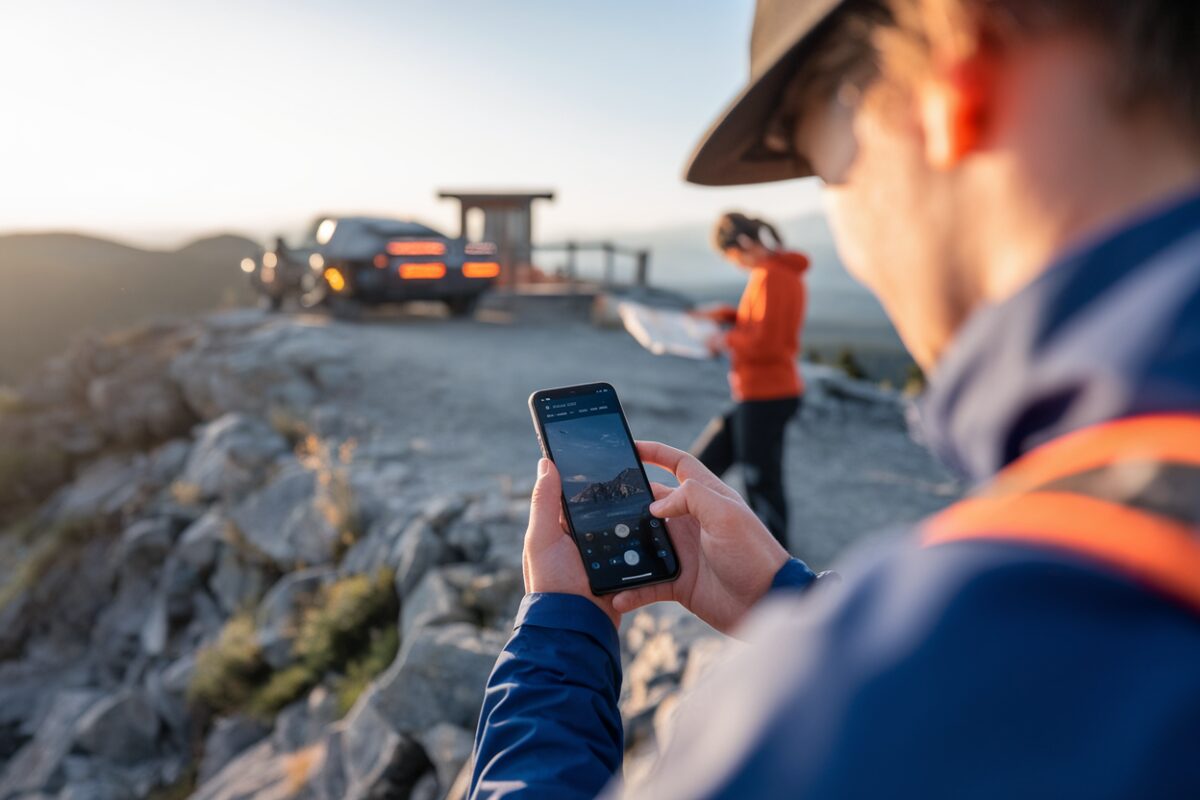
Elon Musk is pushing Starlink into a new promise that sounds like science fiction but is quickly turning into a real product: your regular smartphone connecting to a “cell tower in space” when you’re out of range of traditional service.
The effort, called “Direct to Cell”, isn’t about selling a “Starlink phone” at the mall. It’s about making everyday LTE smartphones capable of basic satellite connectivity, so you can still get a message out on a remote highway, a mountain trail, or miles offshore.
And in the U.S., it’s already taking shape through T-Mobile, which has begun rolling out a Starlink-powered add-on designed to kick in automatically when the bars disappear.
How “Direct to Cell” turns satellites into LTE towers
The core idea is surprisingly straightforward: some Starlink satellites in low Earth orbit carry cellular hardware that behaves like an LTE antenna, except it’s moving overhead at orbital speed.
Your phone doesn’t become an old-school satellite phone. It stays a normal smartphone, scanning for a network. When there’s no nearby terrestrial tower, it can latch onto a signal coming from space, no external antenna, no accessory, no Starlink “pizza box” terminal like the one used for home internet.
That simplicity is the point. If it works at scale, it could extend basic connectivity into the kinds of dead zones Americans know well: desert stretches, mountain passes, rural backroads, and open water, places where you can see the sky but not a cell tower.
There are tradeoffs. Satellites hand off coverage from one to the next, and your phone has to reconnect in the background. That means delays can happen, especially for messaging, because the link depends on satellite position and radio conditions. This isn’t fiber. It’s not even dense 5G. It’s a safety net.
T-Mobile has framed the problem in stark terms, citing more than 500,000 miles of U.S. territory beyond the reach of traditional towers. The pitch isn’t “better service downtown.” It’s “don’t go silent when you’re stranded.”
T-Mobile’s T-Satellite: a $10-a-month add-on, even if you don’t use T-Mobile
T-Mobile has packaged the Starlink tie-up into an offering it calls T-Satellite. The carrier says compatible phones will automatically switch to satellite when terrestrial coverage drops, and users will see a dedicated network name appear on their screens.
The pricing is designed to widen the funnel: T-Mobile is offering the satellite option for $10 a month, including to people who aren’t even T-Mobile customers. That’s a notable move in a U.S. wireless market where most features are locked inside your carrier plan.
In plain terms, T-Mobile is pitching this as a layer you can add on top of your existing service, an “off-grid” backstop, without forcing you to change providers. For Musk, it’s also a way to get Starlink into people’s pockets without manufacturing a phone.
Compatibility is another selling point. T-Mobile says most smartphones from the last four years should be able to use the service, with behind-the-scenes optimization work done with device makers. That’s a major shift from traditional satellite solutions, which often required specialized, expensive hardware aimed at niche users.
As for where it works, T-Mobile has described coverage that includes the continental U.S., Puerto Rico, Hawaii, and surrounding areas, with expansion mentioned toward Canada and New Zealand. It’s not global on day one, and the carrier warns messages may be slower because satellites move and connections can vary.
SpaceX’s next hurdle: enough satellites to make it feel seamless
The make-or-break factor is satellite capacity. Starlink already operates thousands of satellites for broadband internet that requires a ground terminal, but direct-to-cell is its own buildout with its own timeline.
SpaceX has pointed to a goal of at least 300 fully operational direct-to-cell satellites by the end of 2025 to support worldwide mobile coverage. That number underscores the reality: this is a rollout, not a switch flip.
Meanwhile, T-Mobile has said 451 satellites dedicated to direct-to-cell connectivity have already been launched. “Launched,” though, doesn’t automatically mean uniform service everywhere. Coverage and performance ramp up in stages as satellites become operational and networks are tuned.
Low Earth orbit helps by reducing distance compared with old geostationary satellites, improving latency and lowering the power needed to connect. But it also requires a dense, fast-moving fleet. For users, that means frequent handoffs and performance that can depend on a clear view of the sky.
One telecom engineer quoted in the original reporting summed up the tradeoff: you gain minimal continuity, but you lose the stability of a dense terrestrial network. Translation: don’t expect 4K streaming in the woods. Expect the ability to reach someone when you need it most.
Why “no carrier” is more complicated than it sounds
Even if your phone is talking to space, wireless service still runs into Earthbound rules: spectrum licensing, roaming agreements, and national telecom regulations. That’s why Starlink’s direct-to-cell approach is rolling out through partnerships with carriers.
Beyond T-Mobile, Starlink has announced deals with Optus in Australia and Rogers in Canada, and discussions have been reported with multiple European carriers. For consumers, those partnerships determine where the service is available, how it’s priced, and how it’s integrated into existing plans.
The broader logic is easy to grasp. Building and maintaining towers in sparsely populated areas is expensive, and carriers often can’t justify it. Satellites spread the cost across huge territories. But satellites also can’t replicate urban density, indoor coverage, or high-bandwidth reliability. This is resilience, not replacement.
Industry analysts also warn about expectations. If consumers think they’re buying a phone that’s truly “carrier-free,” they may run into limits, geography, slower messaging, and uneven performance. If the marketing outruns the experience, adoption could stall even if the tech is solid.
The “Starlink smartphone” isn’t here, but the no-hardware satellite connection is
Right now, Starlink is selling an ability, not a handset: direct satellite connectivity on existing phones, with no dish and no installation. Musk has a track record of vertical integration, so speculation about a Starlink-optimized phone keeps resurfacing. But there’s no official “Starlink phone” announcement in this rollout.
It also helps to separate Starlink’s products. The familiar Starlink internet service uses a ground terminal, great for homes, RVs, and even planes and trains with the right setup. Direct to Cell is different: it’s designed for the device in your pocket, not the equipment on your roof.
The implications go beyond convenience. For first responders, drivers on isolated roads, boaters, and hikers, the ability to send a message when everything else fails can be the difference between a scare and a tragedy. Starlink has also floated potential extensions to connected vehicles like Teslas, emergency devices, and drones, hinting at a future where satellite fallback becomes a standard safety feature.
For now, the most concrete shift is also the simplest: when you’ve got no bars, your phone may still find a way to connect, by looking up.
Key Takeaways
- Starlink “Direct to Cell” lets LTE smartphones connect to satellites without any additional hardware
- T-Mobile is selling T-Satellite, including to non-customers, for $10 per month
- Coverage depends on a phased rollout, with a goal of at least 300 satellites operational by the end of 2025
- Partnerships with carriers like Optus and Rogers shape access by country
- A “Starlink smartphone” hasn’t been announced, but direct use on existing phones is moving forward
Frequently Asked Questions
Does a smartphone need to be modified to use Starlink Direct to Cell?
No. The stated concept is a direct connection from space to unmodified mobile phones, with no external antenna or accessory. Compatibility depends on specific models and the optimizations done with manufacturers.
What does T-Mobile’s T-Satellite with Starlink actually do?
The service is intended to automatically connect your smartphone to the satellite network when there’s no terrestrial coverage. T-Mobile notes that sending and receiving messages may take longer because the satellites are moving and the phone hands off from one satellite to another.
Does the service replace a standard mobile plan in cities?
No. The goal is to fill in no-coverage areas, not to replace the capacity and stability of a dense terrestrial network. Performance and availability depend on satellite coverage and connection conditions.
When is global coverage targeted for direct-to-cell?
Starlink plans a gradual rollout. One stated target is to have at least 300 fully operational satellites by the end of 2025 to provide worldwide mobile coverage, depending on agreements and deployments.
Is there already a “Starlink smartphone” sold by Elon Musk?
No. The available information is about a direct satellite connectivity service usable on compatible smartphones through partnerships with carriers. The idea of a dedicated phone remains speculation, not an official announcement based on the information provided.
Sources
- Starlink – Wikipedia
- Starlink active l’internet satellitaire sur mobile : pas besoin d’installation ni de changer de téléphone
- What is Starlink? How to get the satellite service for free on your phone with T-Mobile, plus everything you need to know | TechRadar
- T-Satellite with Starlink: Direct to Cell Satellite Phone Service
- Satellite 101: How Does Satellite Phone Service Work? | T-Mobile

- Eurostar lance son application ChatGPT pour préparer ses voyages en Europe - août 18, 2026
- Tanguy Matériaux optimise la gestion de sa flotte et réduit sa consommation de carburant grâce à la télématique Webfleet et l’accompagnement de Katalii - juillet 15, 2026
- Défilé du 14 juillet 2026, cérémonie militaire à Paris, forte exposition médiatique, ce que l’État donne à voir - juillet 14, 2026
