


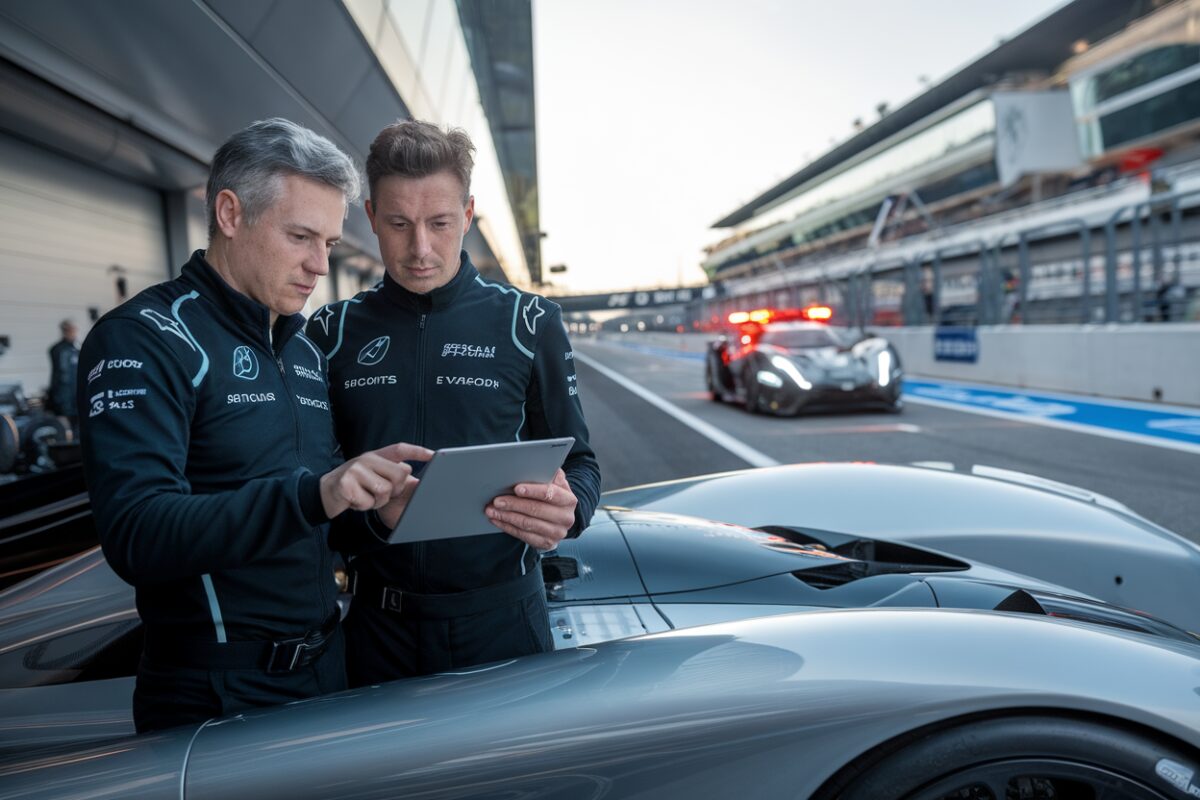
Cadillac woke up on top at the 24 Hours of Le Mans. Now it has to survive the hardest part: staying there.
After 15 hours of racing at the legendary French endurance classic, think Daytona’s 24-hour grind, but on a 8.47-mile public-road circuit, Cadillac’s No. 12 Hypercar is leading a tightly packed front group. BMW’s No. 20 is right in the hunt, Toyota has muscled back into contention with two cars, and Ferrari, the pre-race favorite, has slipped down the order after penalties and mechanical trouble.
Overnight, the fastest prototypes kept blasting down the Mulsanne Straight at roughly211 mph(about 340 km/h), threading through slower traffic and cycling through high-stakes pit stops where a few seconds can flip the leaderboard.
Cadillac’s No. 12 inherits the lead after a major retirement
Cadillac’s lead isn’t a fluke. It’s the direct result of Le Mans doing what Le Mans always does: punishing anything less than bulletproof reliability.
The American brand arrived with three Hypercars, but one of its key entries, No. 38, dropped out with a steering failure. That single mechanical break erased hours of work and instantly reshaped Cadillac’s race, leaving the No. 12 (driven by Norman Nato, Louis Delétraz, and Will Stevens) as the team’s best shot at a breakthrough win.
And the pressure changes when you go from hunter to hunted. Leading at Le Mans means managing traffic, tires, yellow-flag periods, and pit execution, without getting baited into reacting to every move behind you.
The No. 38 retirement also stung for American racing fans: Sébastien Bourdais, a former IndyCar champion and longtime endurance standout, was in that car. Le Mans has been a recurring near-miss for him, his best finishes are three runner-up results across 21 starts, and this one ended before the race reached its most strategic phase.
BMW stays on the lead lap despite trouble for its pole-sitting sister car
BMW hasn’t blinked. With about nine hours still left until the checkered flag, the No. 20 BMW (Robin Frijns, René Rast, and Sheldon van der Linde) remains in the lead-lap fight, close enough that every pit stop feels like a head-to-head bout.
BMW’s other top entry, the No. 15, which started from pole in front of an estimated400,000fans, took a hit after contact with a slower car and had to pit for repairs, dropping it down the standings. That’s Le Mans in a sentence: you can be the fastest car on Saturday, then lose minutes on Sunday morning in what looks like a routine traffic incident.
Still, BMW’s race is very much alive because the No. 20 stayed clean and stayed strategic, avoiding messy laps stuck behind GT3 cars and minimizing time lost on pit exit. Over 24 hours, those “small” losses add up like compound interest.
Toyota claws back from 14th with split fuel strategy
Toyota’s presence near the front by dawn is one of the race’s biggest swings. The two Japanese Hypercars started a brutal14th and 15thon the grid, an uphill climb in a field this tight.
But Toyota played the long game, offsetting fuel and pit windows to find clean air while others got trapped in traffic. After 15 hours, the No. 8 Toyota (Sébastien Buemi, Brendon Hartley, and Ryo Hirakawa) is cycling in and around the lead group depending on pit timing, with the No. 7 also in the mix.
Clean air isn’t just about speed, it’s about survival. Fewer risky passes, less tire abuse, fewer chances to make a fatigue-fueled mistake in the dark. Toyota’s approach has put both cars in position to pounce if Cadillac or BMW stumbles.
Ferrari falls back after penalties and a mechanical issue
The shocker: Ferrari isn’t controlling this race.
The Italian powerhouse, winner at Le Mans in recent years and widely viewed as the team to beat, was running around7th, 8th, and 17that a key point in the morning. That’s not game over at Le Mans, but it forces Ferrari into recovery mode instead of dictating the pace.
The problems have stacked up: mistakes, penalties, including afour-secondsanction that can snowball into a compromised pit cycle, and a mechanical issue for the No. 50 that pushed it further back. In a lead-lap fight this tight, even tiny disruptions can shove you into traffic and wreck your strategy.
Ferrari’s slip has opened the door for Cadillac and BMW to fight it out up front, but it also creates a trap. If the leaders get too aggressive and start trading punches, Ferrari can quietly reel them back in by simply running clean laps.
A pre-race warning sign: Cadillac and BMW were separated by 0.005 seconds
This showdown didn’t come out of nowhere. Before the green flag, Cadillac and BMW were already locked together on the stopwatch.
In Hyperpole qualifying, Cadillac’s Jack Aitken initially grabbed the top spot by just0.005 secondsover BMW’s Dries Vanthoor, a photo finish at 200-plus mph. But a post-session penalty flipped the pole to BMW’s No. 15, a reminder that at Le Mans, you can win on track and lose on paperwork.
That razor-thin gap has shown up in the race. When cars are this evenly matched, the winner usually isn’t the one with the flashiest lap, it’s the team that avoids penalties, nails pit stops, and keeps its drivers out of trouble in traffic when exhaustion sets in.
Key Takeaways
- Cadillac No. 12 leads after 15 hours, but Cadillac lost No. 38 due to a steering failure.
- BMW stays in contention with No. 20, despite No. 15 dropping back after a collision.
- Toyota has closed back up to the leading trio thanks to offset pit stops and a charge from 14th place.
- Ferrari drops back after penalties and a mechanical issue, opening up the fight for the win.
Frequently Asked Questions
Who was leading the 24 Hours of Le Mans at daybreak after 15 hours of racing?
After 15 hours of racing, the No. 12 Cadillac driven by Norman Nato, Louis Delétraz, and Will Stevens was in the lead, with BMW and Toyota close behind depending on pit-stop cycles.
Why did the No. 38 Cadillac retire?
The No. 38 Cadillac retired after a steering failure before 8:00 a.m., ending the race for Sébastien Bourdais and his teammates Earl Bamber and Jack Aitken.
How did Toyota get back into contention after starting 14th and 15th?
Toyota benefited from an offset fueling strategy, which allowed it to run more in clean air and gradually work its way back toward the lead group, especially with the No. 8.
What hurt Ferrari during the night?
Ferrari piled up mistakes, a four-second penalty for an infraction, and a mechanical issue on the No. 50, which caused it to drop down the order by daybreak.
Why did pole position switch from Cadillac to BMW before the race?
Cadillac had secured pole on track by 0.005 seconds, but a post-session penalty dropped the car in question down the grid, handing pole to the No. 15 BMW.
Sources
- 24 heures du Mans: une Cadillac en tête, une autre abandonne
- 24 heures du Mans : Cadillac mène au matin, Ferrari décroche
- Le Mans 24h: Cadillac snatches pole away from BMW by 0.005s …
- La BMW n°15 partira en pole position des 24 heures du Mans après …
- Cadillac snatches Le Mans pole by 0.005 seconds, then loses it to BMW after penalty – The Athletic

- Blocage en cours devant l’Institut Catholique de Paris : mobilisation inédite au cœur du 6ᵉ arrondissement - octobre 8, 2026
- Retour en classe ou poursuite des blocages ? Journée test dans les lycées face à la mobilisation des élèves - octobre 7, 2026
- Suspension des cours face à la mobilisation lycéenne : une fin de semaine sous tension - octobre 6, 2026
