


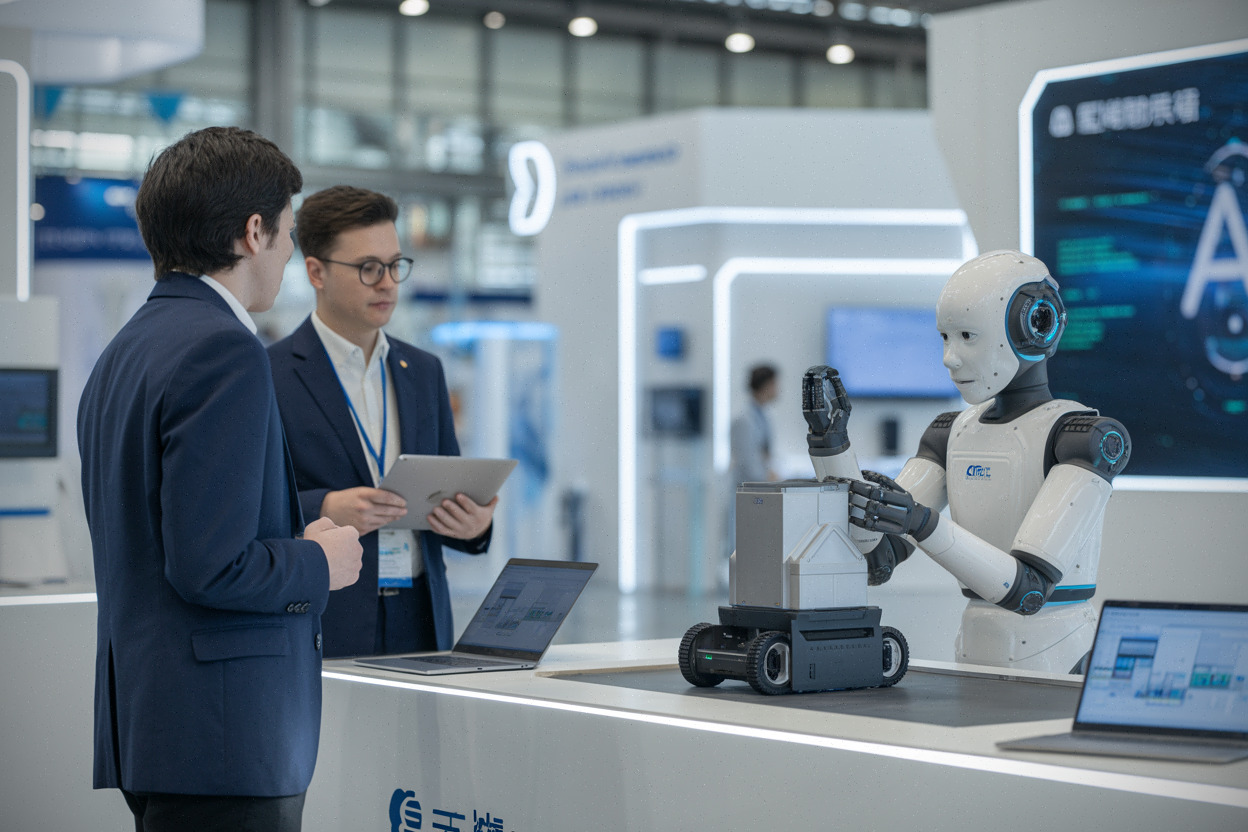
Shanghai Electric used one of the world’s biggest AI showcases to send a clear message: China doesn’t just want smarter chatbots, it wants smarter factories.
At WAIC 2026, the World Artificial Intelligence Conference in Shanghai, the industrial giant rolled out a lineup of “embodied AI” robots, machines designed to perceive the real world, make decisions fast, and physically act inside busy production plants. The company also pitched what it calls an “AI-native” smart factory model, built from the ground up around continuous data and real-time decision-making.
The appearance, highlighted in a Yahoo Finance France report, underscores a broader shift in manufacturing: companies are moving beyond pre-programmed automation toward systems that can adapt on the fly, spotting defects, rerouting around obstacles, and adjusting work based on what sensors and cameras detect.
What “embodied AI” means on a factory floor
In plain English, “embodied AI” is artificial intelligence that doesn’t live only on a screen. It’s AI paired with a physical body, robot arms, mobile platforms, and sensor suites, that can interact with tools, parts, people, and safety constraints in real time.
That matters because real factories are messy. Parts vary. A workspace gets crowded. A component arrives slightly misaligned. Traditional industrial robots excel at repeating the same motion thousands of times. Embodied AI aims to let robots adjust when conditions change, handling variable parts, navigating cluttered areas, or tweaking a movement after detecting a flaw on the line.
For Shanghai Electric, best known historically for heavy industrial equipment and power infrastructure, the pitch is also about repositioning. The company is signaling it can deliver integrated packages where robots, software platforms, and supervisory control systems all talk to each other, targeting manufacturers trying to cut downtime, reduce scrap, and speed up production cycles.
What Shanghai Electric didn’t provide, at least publicly, were the details U.S. manufacturers would immediately ask for: pricing, a commercial rollout timeline, or how many pilot sites are already running these systems. In industrial robotics, a slick demo is easy; proving reliability over months of production, maintenance cycles, and safety audits is the real test.
An “AI-native” factory: built for real-time decisions, not bolt-on dashboards
Shanghai Electric’s “AI-native” factory concept is a bet that AI shouldn’t be an add-on layered over old equipment. Instead, the factory’s digital backbone, planning tools, robots, machines, and control rooms, would be designed from day one to feed a shared stream of data into predictive and decision-support models.
In that setup, AI can analyze a flood of industrial signals at once: equipment temperature, line speed, motor vibration, energy use, defect rates, parts availability, and supply quality. The goal is to catch anomalies early, predict failures, and recommend adjustments before a small issue becomes an expensive shutdown.
The payoff isn’t just productivity. AI-driven operations can help plants balance speed, quality, and energy consumption, an increasingly important tradeoff as manufacturers face higher power costs and tighter customer requirements. In precision-heavy sectors, think electrical equipment, batteries, and mechanical components, even a small reduction in scrap can translate into major savings.
But the concept has a weak link: data integrity. AI is only as good as the sensor calibration, network reliability, cybersecurity, and the people who interpret the system’s recommendations. Bad data can drive bad decisions, especially in tightly coupled production lines where one mistake cascades across multiple machines.
Where these robots could show up first: inspection, internal logistics, assembly
The most likely early uses for embodied-AI robots are jobs where conditions change and human labor is costly, exhausting, or risky. That includes visual inspection, parts handling, feeding assembly stations, and moving materials around a plant.
Quality control is a natural fit. Pair a camera with an AI model that can spot tiny deviations in a surface, weld, or assembly, and connect it to a robot arm, and the system can isolate a suspect part, trigger a secondary check, or adjust a tool position. The value is the closed loop: see, analyze, act, without handing the problem off between disconnected systems.
Internal logistics is another practical target. Mobile robots can shuttle components between storage, assembly, and shipping areas. Their advantage grows when they can reroute around obstacles, prioritize urgent jobs, and coordinate with scheduling software. For plants producing shorter runs and more product variation, that flexibility can beat fixed conveyor systems that are expensive to reconfigure.
Predictive maintenance rounds out the list. Inspection robots tied into machine data can flag early warning signs, unusual noise, overheating, vibration, or leaks, helping reduce unplanned downtime. But it also shifts the workforce: operators need training to understand alerts, know when to override automation, and document issues. The expertise doesn’t disappear; it moves up the chain into supervision and decision-making.
Why WAIC 2026 matters: China’s push to own industrial AI
WAIC has become more than a tech expo for algorithms and consumer apps. It’s increasingly a stage for AI systems that act in the physical world, inside factories, warehouses, energy networks, and urban infrastructure. Industrial robotics sits at the center of that shift.
Shanghai Electric is operating in a national environment that strongly favors automation. Chinese manufacturers are under pressure to boost productivity and move up the value chain, while global supply-chain tensions have made domestically controlled equipment and vertically integrated systems more attractive.
And this isn’t just about China’s domestic market. Companies that can deliver end-to-end packages, robots plus AI software plus factory control, are also eyeing overseas customers modernizing older plants. For U.S. and other international buyers, the deciding factors won’t be buzzwords. They’ll be compatibility with existing equipment, compliance with local standards, cybersecurity assurances, service response times, and parts availability.
Shanghai Electric’s WAIC showing lands in a moment when industrial competitiveness and national strategy are increasingly intertwined. The next question is whether these “embodied AI” robots and AI-native factory systems move from conference-floor demos into routine, scaled deployments, and how quickly competitors respond.


Key Takeaways
- Shanghai Electric showcased its embodied AI robots at WAIC 2026.
- The AI-native factory aims for faster, more precise industrial operations.
- Target use cases include inspection, internal logistics, assembly, and maintenance.
- Data reliability remains central to industrial deployments.
- China is strengthening its position in AI applied to automation.
Frequently Asked Questions
What did Shanghai Electric showcase at WAIC 2026?
Shanghai Electric showcased a lineup of robots with embodied intelligence and AI-native smart factory solutions, focused on connected manufacturing, industrial robotics, and real-time operations management.
What does embodied intelligence mean for an industrial robot?
Embodied intelligence refers to a robot’s ability to use AI to perceive its environment, interpret a situation, and take physical action. In a factory, this can include inspection, parts handling, or autonomous navigation.
Why are manufacturers interested in AI-native factories?
An AI-native factory is designed to leverage production data from the ground up. It can help reduce defects, predict failures, improve traceability, and adjust production rates based on operational needs.
Are these solutions already deployed at scale?
The available information covers the WAIC 2026 showcase. Details on commercial timelines, pricing, and the number of deployed sites were not specified in the reported announcement.

- Les trajets domicile-travail, repenser les accessoires du quotidien - septembre 9, 2026
- Chauffeur privé de prestige : la mise à disposition pour dirigeants et VIP à Bordeaux - septembre 7, 2026
- L’application Leocare est-elle la plus téléchargée dans l’assurance en France ? - août 25, 2026
